


Services
Minimally Invasive Spine Surgery
Endoscopic Spine Surgery
Spinal Fractures & Trauma
Spinal Tuberculosis
Spine Infections
Degenerative Spine Conditions
Spinal Deformities
Osteoporotic Spine Fractures
Ankylosing Spondylitis
Robotic & Navigation-Assisted Spine Surgery
Scoliosis
Kyphosis
Cervical & Lumbar Disc Prolapse
Cervical Myelopathy
Lumbar Canal Stenosis
Advanced Pain Management Techniques
Minimally Invasive Spine Surgery
Endoscopic Spine Surgery
Spinal Fractures & Trauma
Spinal Tuberculosis
Spine Infections
Degenerative Spine Conditions
Spinal Deformities
Osteoporotic Spine Fractures
Ankylosing Spondylitis
Robotic & Navigation-Assisted Spine Surgery
Scoliosis
Kyphosis
Cervical & Lumbar Disc Prolapse
Cervical Myelopathy
Lumbar Canal Stenosis
Advanced Pain Management Techniques
Cervical & Lumbar Disc Prolapse
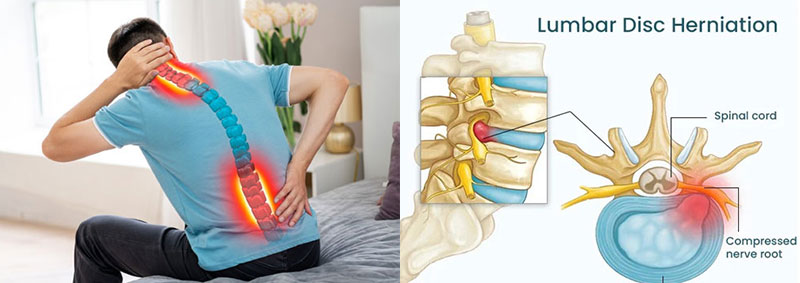
A disc prolapse (commonly referred to as a herniated disc or slipped disc) occurs when the soft center of a spinal disc pushes through a tear in the outer layer, compressing nearby nerves. This can happen in both the cervical (neck) and lumbar (lower back) regions.
Symptoms:
- Cervical Disc Prolapse: Neck pain, radiating pain into the shoulders and arms, numbness or tingling in the hands, weakness in the arms or hands.
- Lumbar Disc Prolapse: Lower back pain, radiating pain into the buttocks or legs (sciatica), numbness or tingling in the legs or feet, weakness in the legs.
Conservative Treatment Options:
1. Medications:
- Nonsteroidal anti-inflammatory drugs (NSAIDs): To reduce pain and inflammation.
- Muscle relaxants: For spasms that may occur due to disc prolapse.
- Oral corticosteroids: In some cases, short-term use of steroids can help reduce severe inflammation.
2. Physical Therapy:
- Cervical Disc Prolapse: Neck exercises, postural training, and traction can relieve nerve compression and improve mobility.
- Lumbar Disc Prolapse: Core-strengthening exercises, stretching, and physical therapy modalities such as traction can reduce the pressure on the affected nerve roots and provide relief.
3. Epidural Steroid Injections:
- For patients who don’t respond to medication and therapy, epidural steroid injections can reduce inflammation around the affected nerves, offering temporary relief.
4. Lifestyle Modifications:
- Avoid heavy lifting or sudden movements that can aggravate the condition.
- Adopting a proper posture, both when sitting and standing, to minimize stress on the spine.
